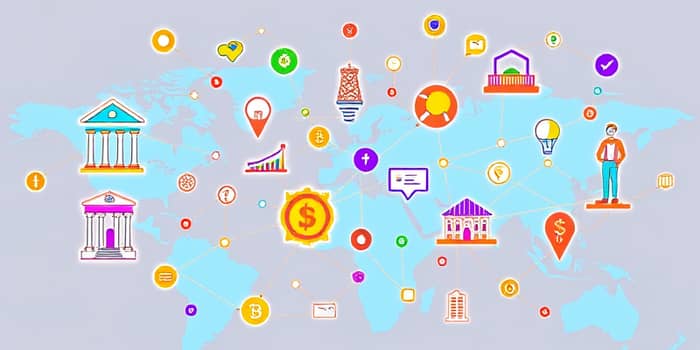
Every individual and business operates within a larger context of financial relationships, technologies, and regulations. Recognizing how these elements interweave can empower better decisions, stronger resilience, and lasting growth.
In this article, we explore the concept of financial ecosystems, identify the key actors and functions, and map out a personal finance framework that helps you visualize and enhance your own financial well-being.
Understanding Financial Ecosystems
Financial ecosystems are interconnected networks of private and public actors that collaboratively provide services, allocate capital, and manage risk across regions. They include banks, fintech startups, BigTech platforms, enterprises, individual customers, and regulators—all interacting dynamically to meet evolving demands.
Unlike linear markets, ecosystems favor flexible network-based governance. There is no single central leader; instead, participants co-evolve through modular partnerships, shared infrastructure, and adaptive rules, responding rapidly to technological, regulatory, and behavioral shifts.
Key Actors and Core Functions
Within any financial ecosystem, actors exhibit duality between roles (for example, a household can be both saver and borrower), hybridity in functions, and fluidity during crises, shifting responsibilities as needs change.
Regardless of their label, all actors perform timeless functions: allocating funding, transforming maturities, pooling and transferring risk, reducing transaction frictions, and providing liquidity.
Mapping Your Personal Finance Ecosystem
To visualize the factors influencing your financial well-being, the NEFE framework uses layered components that reflect real-world complexity without claiming direct causation.
- Foundational Factors like literacy, inclusion, values, family culture, and geographic barriers
- Financial Actions & Outcomes encompassing mindset, choices, decisions, outcomes, and unexpected events
- Catalysts for Change such as educational programs, social supports, behavioral nudges, and policy shifts
This roadmap reveals how your knowledge, attitudes, and environment combine to shape decisions like saving, investing, or borrowing, and ultimately determine your ability to absorb financial shocks.
Foundational Factors at Work
The first layer includes universal influences: financial knowledge and skills, access and inclusion, general competencies, values and beliefs, family and culture, and socioeconomic or geographic conditions.
- Financial literacy and numeracy allow you to compare products and negotiate effectively.
- Access to bank accounts, credit products, or digital platforms determines your opportunity set.
- Cultural attitudes toward money and risk shape your default mindset and willingness to innovate.
Improving even a single factor—say by building stronger budgeting skills—can create ripple effects across the entire ecosystem of your personal finances.
Actionable Catalysts for Change
Individuals and organizations can activate several leverage points to shift trajectories. Targeting these catalysts helps you develop deeper financial acuity and more robust outcomes.
- Knowledge influencers through workshops, online courses, and one-on-one coaching
- Social and material supports such as community programs, safety nets, and public benefits
- Behavioral nudges like automated savings, peer comparison, and goal reminders
- Structural policy changes that expand access, lower fees, and strengthen consumer protections
For example, a targeted homebuyer education workshop can boost confidence, clarify choices, and improve loan terms, illustrating how tailored interventions drive meaningful progress.
Drivers Shaping Ecosystem Evolution
Dynamic forces compel adaptation across all financial networks. Understanding these drivers equips you to anticipate changes and leverage new opportunities.
- Technological Innovations like blockchain, artificial intelligence, and digital wallets
- Legal and Regulatory Shifts including contracts, property rights, and global standards
- Behavioral Tendencies shaped by biases, habits, and social norms
- Geopolitical and Economic Pressures that drive market realignments
- Informational Advances reducing asymmetries through data analytics and network sharing
By aligning your strategies with these trends, you ensure your personal finance ecosystem remains agile, resilient, and forward-looking.
Transforming Through Collaboration
Successful ecosystems evolve through partnerships, shared value creation, and continuous innovation. Examples from the UK show banks, fintech firms, and regulators co-creating seamless digital experiences that enhance inclusion and efficiency.
Embrace collaborative models by seeking tools and communities that integrate budgeting apps with investment platforms or pairing peer support groups with credit-building services. Such alliances multiply impact beyond any single intervention.
Governance and Stability
Rather than relying on rigid hierarchies, modern financial ecosystems maintain stability through adaptive capacity under constraints. Participants self-organize around projects, territories, and value streams, guided by shared standards, community norms, and evolving policies.
When disruptions occur—whether market downturns or technological shifts—ecosystems with decentralized governance can reconfigure quickly, isolate contagion, and restore equilibrium.
Connecting the Dots for Lasting Impact
Your personal finance ecosystem is not a static plan but a living network of relationships, resources, and routines. By visualizing interconnected components, identifying leverage points, and engaging with collaborative partners, you cultivate stronger resilience and more sustainable growth.
Start by mapping your own ecosystem: list your fund providers and users, assess foundational factors, and choose one catalyst to activate this month. Track progress, refine actions, and watch how small adjustments can unlock significant transformations.
Ultimately, recognizing the networked nature of financial well-being empowers you to navigate complexity, anticipate challenges, and seize opportunities with confidence. Connect the dots, build your ecosystem, and chart a path toward lasting prosperity.
References
- https://jemi.edu.pl/call-for-papers-archive/603-financial-ecosystems-concepts-and-practice
- https://anandautar.substack.com/p/the-financial-ecosystem-a-foundational
- https://www.youtube.com/watch?v=TUVG8pAbm54
- https://www.zuehlke.com/en/insights/financial-services-ecosystem-guide
- https://www.youtube.com/watch?v=QTY6mel8iuw
- https://lifestyle.sustainability-directory.com/area/financial-ecosystems/
- https://www.nefe.org/initiatives/ecosystem/default.aspx
- https://www.ey.com/en_gl/industries/financial-services/ecosystems-financial-services/how-harnessing-the-power-of-ecosystems-can-make-finance-effortless
- https://www.nefe.org/initiatives/default.aspx
- https://rpc.cfainstitute.org/research/cfa-magazine/2017/financial-ecosystems-a-survival-guide
- https://scholarworks.iu.edu/dspace/bitstreams/412b3fb4-1a9a-4221-9bc0-124ffa10f2ba/download
- https://www.occ.gov/topics/consumers-and-communities/community-affairs/resource-directories/financial-literacy/index-financial-literacy-resource-directory.html
- https://sswr.confex.com/sswr/2026/webprogram/Session16484.html