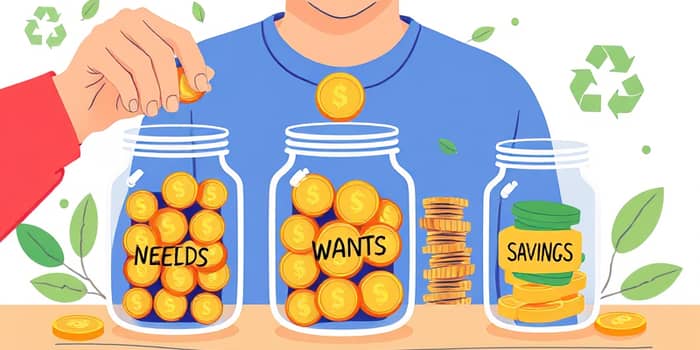
In a world where financial clutter often leads to stress and wasted resources, a transformative approach awaits.
The zero-waste budget, rooted in zero-based budgeting, promises to revolutionize your money management.
By ensuring every dollar has a clear purpose, it eliminates excess and builds financial security.
This method requires justifying all expenses from scratch each month.
It aligns spending with your true priorities, cutting out the noise of habitual waste.
Imagine a life where money works for you, not against you.
Embrace this disciplined path to turn financial chaos into clarity and control.
Why Traditional Budgets Often Fail
Traditional budgeting methods rely heavily on historical spending patterns.
They adjust incrementally from prior periods, often leading to unchecked increases.
This momentum budgeting results in budget bloat over time.
Unnecessary expenses get carried forward without question.
In contrast, zero-based budgeting forces a complete reset each cycle.
It challenges you to evaluate every cost based on current needs.
This proactive approach prevents financial drift and promotes efficiency.
The Historical Origins of Zero-Based Budgeting
Zero-based budgeting has a rich history dating back to the 1970s.
It was developed by Peter Pyhrr, a manager at Texas Instruments.
His goal was to optimize resource allocation by avoiding historical inertia.
Key milestones in its evolution include:
- Adoption by the U.S. federal government under President Carter in 1977.
- Initial challenges with excessive paperwork and complexity.
- Gradual adaptation into personal finance for zero-waste spending.
This journey highlights its versatility from corporate to individual use.
It underscores the timeless value of scrutinizing resources from a zero base.
How Zero-Based Budgeting Works: A Step-by-Step Guide
Implementing zero-based budgeting in your personal finances is straightforward.
It begins with resetting your budget to zero each month.
Here is a detailed process to follow:
- Reset to zero: Start with your total monthly income as the base.
- Identify goals and categorize: List priorities like needs, wants, and savings.
- Evaluate functions and expenses: Review all spending categories from housing to entertainment.
- Justify and prioritize: Assess each expense for necessity and alignment with goals.
- Allocate and track: Assign every dollar and monitor monthly adjustments.
- Review and rank: Rank expenses by impact to optimize allocations.
This ensures no dollar is left unaccounted for in your financial plan.
It fosters accountability and intentional decision-making with your money.
Practical Example: A Monthly Zero-Based Budget
To illustrate, consider a monthly income of $5,000.
Using the 50/30/20 rule as a benchmark, funds can be allocated effectively.
This table demonstrates how every dollar serves a purpose.
It emphasizes the importance of justifying each expense category clearly.
Advantages of Adopting a Zero-Waste Budget
Zero-based budgeting offers numerous benefits for personal finance.
Here are some key advantages that can transform your financial life:
- Cost savings: Identifies and cuts wasteful spending like redundant subscriptions.
- Better allocation: Aligns spending with goals, boosting savings and debt payoff.
- Accountability: Forces detailed justification, improving financial habits over time.
- Flexibility: Adapts to life changes such as job loss or salary increases.
- Efficiency gains: Can reduce costs by 10-50% through thorough analysis.
These advantages make it a powerful tool for financial discipline.
It empowers you to make intentional choices with your money.
Disadvantages and Challenges to Consider
While beneficial, zero-based budgeting has some drawbacks.
It's important to be aware of these challenges to adapt effectively:
- Time-intensive: Requires detailed analysis each period, which can be demanding.
- Subjectivity: Defining minimal viable spending can be arbitrary and personal.
- Not for everyone: Best for disciplined users; might overwhelm complex finances.
- Implementation hurdles: Full zero-review annually may be impractical; consider rolling reviews.
Despite this, most people can benefit from its principles with adjustments.
Finding a balance that suits your lifestyle is key to success.
Zero-Based Budgeting vs. Traditional Budgeting
Understanding the differences helps in choosing the right method.
Here is a comparison to highlight key aspects:
- Starting Point: ZBB starts from zero; traditional from prior year plus increments.
- Focus: ZBB on current needs and efficiency; traditional on historical patterns.
- Flexibility: ZBB is high; traditional is low and status quo-oriented.
- Cost Control: ZBB is strong; traditional is weaker with unchecked increases.
- Time Required: ZBB is high; traditional is low and quicker to implement.
This shows why ZBB can be more effective for cutting waste.
It encourages a proactive rather than reactive financial approach.
Real-World Examples and Advanced Tips
To make zero-based budgeting work, learn from practical applications.
For instance, in manufacturing, resources are scrutinized like production lines.
Apply this to personal finance by comparing grocery spending to dining out.
Here are some advanced tips for enhanced success:
- Use budget apps to track spending and ensure zero balance automatically.
- Conduct sunset reviews annually to cut unnecessary expenses systematically.
- Make inter-category trades to optimize allocations based on changing priorities.
- Set arbitrary cuts like 10%, 20%, or 50% from prior spending as motivational goals.
- Tie it to zero-waste living for dual financial and environmental benefits.
This integrates financial health with sustainable habits seamlessly.
For example, buying in bulk can reduce costs and minimize waste.
Overcoming Common Objections
Many people hesitate due to the perceived complexity of ZBB.
However, with simple reforms, it can be manageable for everyone.
Consider quarterly reviews instead of monthly to save time and reduce effort.
Use percentage cuts as a simplified version of zero-base justification.
The key is to start small and gradually adopt the full process.
Even partial implementation can yield significant financial benefits and clarity.
Conclusion: Your Path to Financial Freedom
Embracing the zero-waste budget through zero-based budgeting is a journey towards financial clarity.
It transforms how you view and use money, ensuring every dollar contributes to your goals.
By eliminating excess and justifying expenses, you build a foundation for long-term security.
Take the first step today to reset your finances and achieve zero waste.
With discipline and intentionality, you can turn financial stress into empowerment and freedom.
Let this method guide you to a life where money supports your dreams, not drains them.
References
- https://en.wikipedia.org/wiki/Zero-based_budgeting
- https://www.workday.com/en-us/topics/fpa/what-is-zero-based-budgeting.html
- https://www.oracle.com/performance-management/planning/zero-based-budgeting/
- https://www.nerdwallet.com/finance/learn/zero-based-budgeting-explained
- https://yourmoneyvehicle.com/planning/money-tactics-zero-based-budget/
- https://www.golimelight.com/blog/zero-based-budgeting
- https://www.rho.co/blog/zero-based-budgeting
- https://greenkulture.sg/blogs/news/zero-waste-living-on-a-budget-simple-ways-to-save-money-while-saving-the-planet