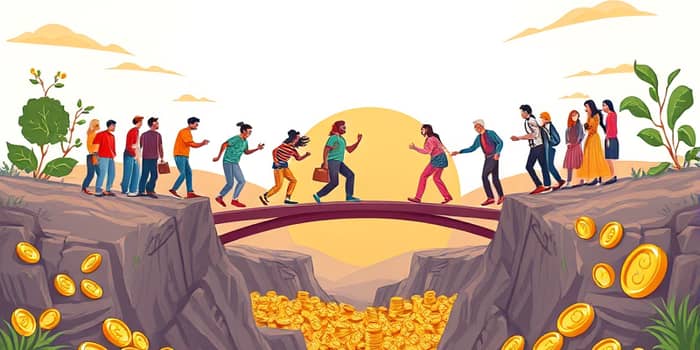
In our interconnected world, the wealth gap is not merely an economic statistic; it is a profound human challenge that echoes through generations and across borders. Understanding this stark reality is crucial for anyone committed to justice and progress.
The disparities in income and wealth shape lives, limit opportunities, and threaten social stability on a global scale. This imbalance undermines social cohesion and hampers collective advancement towards a better future.
Yet, within these daunting figures lies a call to action. By uncovering the roots of inequality and embracing innovative solutions, we can transform despair into hope. Empowering communities through informed action is the first vital step toward change.
The Stark Reality of Global Inequality
The scale of global inequality is both shocking and enlightening. Recent data reveals that the top 10% of adults, approximately 560 million people, receive 53% of global income.
In stark contrast, the bottom 50%, which includes 2.8 billion adults, capture only 8%. This means the richest 1% earn 2.5 times more than the entire bottom half of the population.
Wealth inequality is even more extreme, with disparities growing faster than income gaps. For example, in Europe, the wealth of the top 10% is nearly 200 times that of the bottom 50%.
- The top 10% global income share stands at 53%.
- The bottom 50% global income share is a mere 8%.
- Top 1% income exceeds that of the bottom 50% by 2.5 times.
Extreme concentration is evident, with just 1.6% of adults holding 48% of global wealth. Meanwhile, 82% of adults control only 2.8% of wealth, highlighting a pyramid of disparity.
To illustrate country-level variations, here is a table of wealth inequality measured by Gini coefficients, where higher values indicate more inequality.
Trends show that while globalization has reduced between-country inequality, within-country gaps are widening rapidly. Billionaires' wealth, for instance, rose by $2 trillion in just one year, according to recent reports.
This data underscores the urgent need for intervention. Global wealth concentration is accelerating, making it imperative to act now.
Root Causes of the Wealth Gap
Inequality stems from a complex interplay of historical, economic, and social factors that perpetuate disadvantage. Income versus wealth accumulation is a critical distinction, as capital often concentrates more than labor earnings.
Regional extremes exacerbate the issue, with the highest wealth gaps in the Middle East and North Africa, and North America and Oceania. In these areas, ratios can exceed 520:1.
- Historical rise in average income has not translated into equitable shares, leaving wealth unevenly distributed.
- Racial and structural factors, such as discriminatory policies and tax subsidies, favor the wealthy.
- Early education gaps and low savings rates create barriers to asset-building for marginalized groups.
- Discriminatory laws and school quality disparities hinder upward mobility.
Understanding these causes is essential for developing effective interventions. Addressing systemic barriers requires comprehensive strategies that go beyond temporary fixes.
The legacy of historical injustices, like slavery, calls for reparative measures. Policies must confront deep-rooted inequities to foster genuine change.
Empowering Solutions to Bridge the Divide
Overcoming inequality is achievable through targeted, evidence-based policies that empower individuals and communities. Here are key areas for actionable change.
Savings and asset-building are foundational to economic security. Promoting emergency savings incentives can help families weather financial storms.
- Implement universal children's savings accounts, such as baby bonds.
- Reform safety net asset tests to encourage saving without penalty.
- Establish automatic retirement savings plans for all workers.
- Limit mortgage interest deductions to support first-time homebuyers.
Tax and redistribution policies must be progressive to redistribute resources fairly. Increasing taxes on the ultra-wealthy can fund essential social programs.
- Expand the Earned Income Tax Credit to boost incomes.
- Moderate tax redistribution to enhance public services.
- Shift subsidies from wealthy programs to low-wealth support initiatives.
Education and health investments are critical for breaking cycles of poverty. Investing in early childhood education sets a strong foundation for future success.
- Universal health care, like Medicare for All, ensures access for all.
- Eliminate student debt to relieve financial burdens.
- Provide postsecondary support without loans for greater opportunity.
Other interventions include raising the minimum wage and building working-family assets. These measures can stabilize incomes and promote wealth accumulation.
- Stabilize Social Security to protect retirees from poverty.
- Support entrepreneurship and provide reparations for historical injustices.
- Implement postal banking to increase financial inclusion in underserved areas.
These solutions, when combined, can create a ripple effect of positive change. Building a fairer economy demands bold steps towards equity.
A Path Forward: Combining Policies for Impact
No single policy can solve inequality alone. Effective combinations or 'policy cocktails' are needed to address both symptoms and root causes comprehensively.
Safety nets, progressive taxes, and job creation can mitigate immediate disparities. However, to tackle underlying issues, we must invest in education, health, and early interventions.
- Combine education reforms with health care access for holistic support.
- Integrate asset-building with tax incentives to boost wealth accumulation.
- Align minimum wage increases with affordable housing initiatives.
- Use early childhood programs to break intergenerational poverty cycles.
The United Nations Goal 10 emphasizes eliminating discriminatory policies for equal opportunity, guiding global efforts towards sustainability.
By embracing these strategies, we can move towards a world where prosperity is shared and everyone has the chance to thrive. Together, we can bridge the wealth gap and build a brighter, more inclusive future for all generations.
Let this be a call to action for policymakers, activists, and citizens alike. Change begins with awareness and commitment to justice and equity.
References
- https://wir2026.wid.world/insight/global-economic-inequity/
- https://www.urban.org/2016-analysis/seven-promising-policies-reduce-wealth-inequality
- https://worldpopulationreview.com/country-rankings/wealth-inequality-by-country
- https://belonging.berkeley.edu/six-policies-reduce-economic-inequality
- https://www.visualcapitalist.com/the-global-distribution-of-wealth-shown-in-one-pyramid/
- https://keough.nd.edu/news-and-events/news/effective-policies-for-addressing-economic-inequality/
- https://www.thecanary.co/global/world-analysis/2025/12/12/inequality-gross/
- https://inequality.org/article/ten-solutions-bridge-racial-wealth-divide/
- https://socialcapitalpartners.ca/what-the-new-world-inequality-report-tells-us-and-why-it-matters-for-canada/
- https://www.oxfamamerica.org/explore/issues/economic-justice/extreme-inequality-and-poverty/
- https://siepr.stanford.edu/publications/policy-brief/policy-cocktails-attacking-roots-persistent-inequality
- https://www.un.org/sustainabledevelopment/inequality/
- https://nonprofitquarterly.org/from-precarity-to-promise-how-public-policy-can-reverse-the-wealth-gap/
- https://www.oxfamamerica.org/explore/issues/economic-justice/income-and-wealth-inequality/