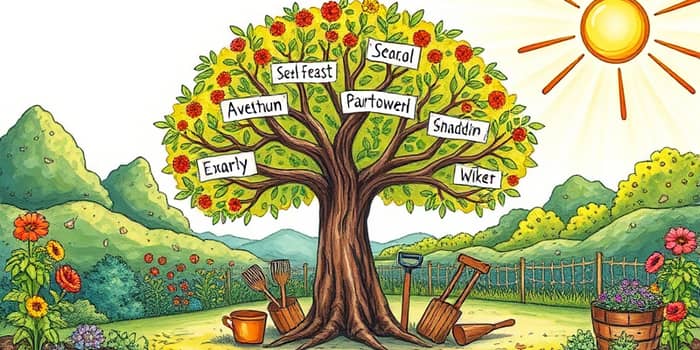
Imagine your wealth as a young sapling, eager to stretch its branches skyward. In 2026, the economic climate offers fertile soil and ample sunlight for those willing to tend their portfolios with patience and precision. This guide will equip you to cultivate a thriving financial tree.
As gardeners of our own prosperity, we must understand the conditions that enable robust growth and prepare for the storms that can threaten our progress.
Preparing the Soil: 2026 Economic Outlook
Before planting seeds, assess soil quality. Economic forecasts for 2026 suggest sturdy nutrient levels to boost your portfolio’s foundation. Real GDP growth of roughly 2.1–2.5% will act as a principal growth nutrient, driven by technology investments, infrastructure spending, and resilient consumer demand.
Monetary policy shifts represent moisture levels in our garden. With inflation stabilizing and the Fed expected to cut rates, liquidity will increase, lowering borrowing costs for businesses and fueling asset valuations.
Fiscal policy acts like fertilizer. The permanent tax relief enacted under the One Big Beautiful Bill Act injects approximately $129 billion in corporate tax savings, encouraging businesses to reinvest in growth.
Planting Your Seeds: Strategic Asset Allocation
Selecting the right seeds is akin to choosing asset classes that will flourish under the prevailing conditions. A diversified portfolio ensures no single downturn uproots your entire tree.
- Main canopy of U.S. equities: The S&P 500 is projected to rise 14%, reaching 7,800 by year-end.
- Roots in fixed income: Equal-weight exposure provides stability; European credit may outperform U.S. bonds.
- Evergreen alternatives: Private equity, private credit, and real estate gain appeal in a lower-rate environment.
Within equities, balance growth and value. Tech and AI names offer innovation-led upside but come with valuation risks. Value sectors—energy, financials, industrials—stand to benefit from rate cuts and cyclical tailwinds.
Cultivating Branches: Business Insights and Trends
Your tree’s branches represent the strategies employed by leading businesses, which can inform personal portfolio decisions. In 2026, companies are adopting innovation as hybrid seeds to drive expansion.
- 73% of firms expect revenue growth, signaling robust demand across sectors.
- 64% forecast profit increases, reflecting improved cost management and pricing power.
- 49% plan strategic partnerships or investments, up from 43% last year.
Emulate these trends by reallocating toward high-conviction themes—such as AI infrastructure demand or healthcare innovation—while periodically pruning underperforming positions.
Weathering the Storms: Risks and Protective Measures
No garden is immune to pests or drought. Rising federal debt—projected to exceed 120% of GDP by 2036—and policy uncertainty pose potential headwinds. Moderate consumer spending and small business constraints can limit growth at the roots.
- Concentrated valuations: Overreliance on mega-cap tech can amplify volatility.
- Debt dynamics: Higher interest expenses may crowd out private investment.
- Income disparities: Lower-income consumer weakness could dampen spending growth.
Diversification and rebalancing serve as protective pruning, ensuring no single risk jeopardizes the entire portfolio. Focus on fundamentals and maintain a long-term horizon to ride out short-term fluctuations.
The Gardener’s Toolkit: Best Practices for Long-Term Growth
Successful gardeners follow a disciplined routine of watering, fertilizing, and pruning. In finance, this translates to regular contributions and reinvestment, periodic rebalancing, and tax-efficient strategies.
Key practices include:
- Establishing an asset allocation that aligns with your risk tolerance and goals.
- Scheduling semiannual portfolio reviews to adjust to changing conditions.
- Leveraging tax-advantaged accounts to maximize after-tax returns.
By applying these methods, you ensure steady nourishment and controlled growth, avoiding the temptation to react hastily to market noise.
As the seasons change, your financial tree will develop deeper roots and stronger branches. With patience, discipline, and a thoughtful strategy, you can harvest the fruits of your labor—be they retirement income, legacy wealth, or funding life’s ambitions.
In 2026’s fertile environment, the most successful gardeners will be those who combine strategic allocation and diversification with attentive maintenance and a steadfast commitment to long-term objectives. Embrace your role as the Growth Gardener, and watch your financial tree reach new heights.
References
- https://www.ameriprise.com/financial-news-research/insights/2026-market-economic-outlook
- https://www.claconnect.com/en/resources/articles/25/2026-cla-outlook
- https://www.pwc.com/us/en/about-us/newsroom/press-releases/annual-outlook-2026.html
- https://www.jpmorgan.com/insights/markets-and-economy/business-leaders-outlook/2026-us-business-leaders-outlook
- https://www.morganstanley.com/insights/articles/stock-market-investment-outlook-2026
- https://www.pinebridge.com/en/insights/investment-strategy-insights-assessing-scenarios-for-our-2026-outlook
- https://www.imf.org/en/publications/weo/issues/2026/01/19/world-economic-outlook-update-january-2026
- https://www.blackrock.com/us/financial-professionals/insights/investing-in-2026
- https://www.cbo.gov/publication/61882