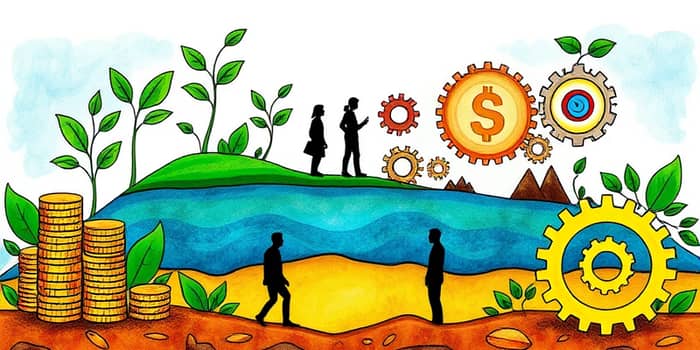
In a world of complex trade-offs, value stacking with capital stacking synergy offers a refreshing lens to build a future where personal, financial, ecological, and systemic goals rise together. By choosing strategies that deliver co-benefits, you can drive long-lasting impacts while securing immediate rewards.
What Are Sustainable Stacks?
Sustainable Stacks merge two powerful ideas: “value stacking,” which layers multiple benefits into a single decision, and “capital stacking,” which layers diverse funding sources—debt, equity, incentives—to fuel growth. This framework transforms choices from zero-sum compromises into opportunities for cumulative advantage.
Imagine a solar installation financed through a blend of tax credits, low-interest loans, and community grants. You enjoy long-term ecological gains tangible via immediate rewards—lower energy bills, new technical skills, and carbon reductions—while funders secure reliable returns.
At its core, Sustainable Stacks build redundant circular systems resistant to failures, ensuring that if one benefit dips, others sustain progress. This approach empowers individuals, households, and organizations to design resilient portfolios of actions and investments.
Understanding Crypto Threats in 2025
As digital assets mature, illicit activity soared. In 2025, illicit crypto inflows hit $158 billion, a staggering 145% jump from 2024, driven by sanctions evasion, hacks, and darknet markets. Sanctions evasion alone accounted for $39 billion tied to a single network, while cross-chain laundering topped $21 billion.
Operational compromises—lost keys, exposed wallets—contributed $2.2 billion of losses across 150 hack incidents, averaging $48.5 million each. North Korean actors increasingly target infrastructure over smart contracts, highlighting the urgency of robust controls.
Stablecoins dominated fraud inflows, making up 84% of illicit volume thanks to high liquidity and anonymity. USDC recorded $9.6 trillion in on-chain volume in Q3 2025, with $217 billion in redemptions—metrics that underscore both opportunity and risk.
Yet platforms can defend users effectively. Binance’s risk controls prevented $6.69 billion in losses for 5.4 million users, cutting illicit exposure by 96%. Global cybersecurity spending is projected to reach $522 billion in 2026, with AI analytics and access controls at the forefront.
Building with Sustainable Finance Tools
Deploying Sustainable Stacks requires familiarizing yourself with finance tools that layer benefits and sources:
- Green and social bonds: Over $600 billion issued in 2020, doubling 2019’s volume and integrating ESG criteria into underwriting practices.
- Clean energy tax credits: The Inflation Reduction Act offers up to 70% boosts on renewables, enabling projects that cut greenhouse gases, create jobs, and foster community resilience.
- Securitization: Pooling assets—loans, leases, receivables—into tradable securities lowers costs and scales climate infrastructure investment.
- Revenue-based financing: Align repayments with cash flow, reducing stress from overlapping obligations and matching debt burden to business performance.
By layered funding sources for sustainable growth, you attract public, private, and philanthropic capital while maximizing impact per dollar invested.
Security as the Foundational Layer
Robust security underpins every Sustainable Stack. Whether you’re a blockchain platform or a small business, protecting assets and data safeguards co-benefits and maintains stakeholder trust.
Integrating AI-enhanced risk detection and analytics into your stack not only thwarts threats but also signals maturity to investors, unlocking further capital.
Strategies for Implementation and Co-benefits
To deploy Sustainable Stacks effectively, focus on sequencing, transparency, and metrics:
- Sequence by purpose: Match financing instruments to specific needs—equipment, payroll, expansion—avoiding cash-flow mismatches.
- Quantify impacts: Track emissions reductions, cost savings, community benefits with clear KPIs to satisfy funders and stakeholders.
- Engage community: Layer local goals with funder objectives—energy efficiency projects can become job-training programs and social enterprises.
- Build flexibility: Incorporate grace periods and revenue-based clauses to absorb fluctuations and maintain resilience.
- Leverage networks: Partner with development finance institutions for de-risking and catalytic grants that draw in private capital.
These tactics generate multi-layered rewards across personal financial ecological social dimensions, anchoring motivation and sustaining momentum.
Looking Ahead: The Future of Sustainable Finance Stacks
By 2026, tokenization will reshape digital asset ecosystems. From fractional real estate to community green bonds, fractionalized tokens promise liquidity, transparency, and democratized access.
Platforms that embed sustainability as a core feature—offering real-time ESG metrics, resilient settlement layers, and inclusive governance—will capture market share and build loyal communities.
As threats evolve, so too will defenses. Expect AI-driven monitoring, self-healing smart contracts, and cross-chain forensic tools to become standard components of every Sustainable Stack.
Ultimately, Sustainable Stacks invite you to imagine finance not as a zero-sum game, but as a tapestry of intertwined benefits. By weaving together personal well-being, financial security, planetary health, and systemic resilience, you can invest with purpose, innovate with intent, and thrive with confidence in an uncertain world.
References
- https://lifestyle.sustainability-directory.com/term/value-stacking/
- https://www.trmlabs.com/reports-and-whitepapers/2026-crypto-crime-report
- https://www.elliptic.co/blog/elliptics-2026-regulatory-and-policy-outlook-next-gen-blockchain-analytics
- https://climatedrift.substack.com/p/the-capital-stack-for-scaling-climate
- https://www.financemagnates.com/thought-leadership/security-spend-is-rising-faster-than-marketing-budgets-and-thats-reshaping-crypto-competition-in-2026/
- https://corporatefinanceinstitute.com/resources/financial-modeling/capital-stack-structure-debt-equity/
- https://www.circle.com/pressroom/from-stablecoins-to-infrastructure-circle-charts-the-rise-of-the-internet-financial-system-in-2026-report
- https://cfgmerchantsolutions.com/the-risks-and-rewards-of-capital-stacking-for-small-business-owners/
- https://www.chainalysis.com/reports/crypto-crime-2026/
- https://sifted.eu/articles/smartest-startups-finance-stack-brnd
- https://www.weforum.org/stories/2026/01/digital-economy-inflection-point-what-to-expect-for-digital-assets-in-2026/
- https://thecleanfight.com/resources/blog/maximizing-clean-energy-benefits-the-art-of-stacking-incentives
- https://www.moodys.com/web/en/us/insights/credit-risk/outlooks/artificial-intelligence-2026.html
- https://www.cohnreznick.com/insights/stack-local-funder-goals-expand-community-benefits