As the global population continues to rise and climate pressures intensify, agriculture stands at a crossroads of innovation and necessity. Investors are increasingly drawn to this sector not only for its potential returns but for its capacity to drive sustainable and profitable farming. By embracing technology and regenerative practices, the agricultural landscape is transforming into a resilient, future-proof asset class.
Today’s investment climate in agriculture is defined by a convergence of capital, cutting-edge science, and a growing consumer demand for transparency and environmental stewardship. From data-driven farms to blockchain-enabled supply chains, the industry is undergoing a profound evolution.
A Thriving Market on the Rise
The numbers speak for themselves. In 2024, the AI in agriculture market was valued at over $1.6 billion, and it is projected to surge to $4.9 billion by 2030 at a remarkable 24.1% CAGR. Food traceability is also booming, set to leap from $19.3 billion in 2025 to $41.8 billion by 2035. Meanwhile, overall AgTech valuations are on track to reach $74 billion by 2034, growing at a steady 12.2% CAGR.
These figures underscore a powerful trend: investors who align with agricultural innovation are poised to reap significant rewards while contributing to global food security and environmental health.
Key Investment Trends for 2026
Understanding where capital flows can guide strategic decisions. The following trends are defining the investment landscape in 2026:
- De-Chemicalization of Agriculture: A shift away from synthetic inputs is driven by rising costs, regulatory pressure, and environmental concerns.
- Regenerative and Sustainable Farming: Funds like Mad Agriculture’s $78 million initiative are financing farmers transitioning to organic, soil-building practices.
- Food Traceability and Transparency: Blockchain and real-time tracking technologies are enabling farm-to-shelf visibility, bolstering consumer trust.
- Livestock Technology: Monitoring systems and precision health tools for animals are attracting growing capital and driving efficiency.
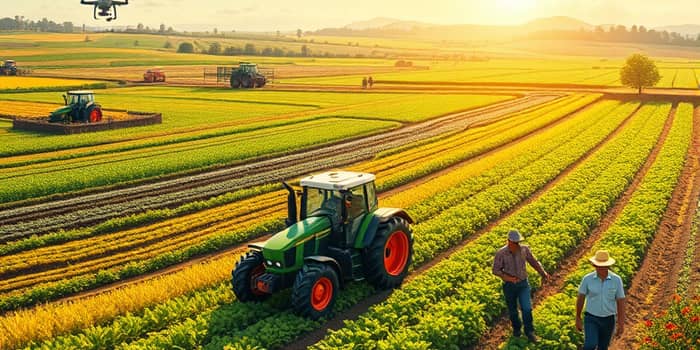
- Precision Agriculture: Autonomous machinery, predictive analytics, and soil sensors are cutting labor and resource costs while optimizing yields.
- AI and Biotech Innovations: Climate-adaptive crops and generative AI tools are empowering faster, data-driven decisions in the field.
Each of these trends represents a pathway to both impact and profit. By targeting innovations that reduce risk and boost output, investors can support the transition to a more resilient agricultural system.
Practical Strategies for Investors
Navigating the agricultural sector demands a thoughtful approach. Here are key strategies to consider:
- Diversify across sub-sectors: Combine investments in AI tools, regenerative practices, and traceability to spread risk.
- Partner with experienced operators: Collaborate with established agribusinesses to leverage their domain expertise and networks.
- Support smallholder inclusion: Invest in scalable solutions that empower small farms in emerging markets, unlocking high ROI potential.
- Emphasize long-term resilience: Prioritize projects that build healthy soils, healthy animals, healthy returns over quick gains.
Investors should also monitor input cost trends, such as fertilizer prices, which spiked 18% in 2025 but are forecast to drop 5% in 2026 as export restrictions ease. Likewise, global food and raw material prices are expected to remain stable, offering a predictable backdrop for long-term planning.
Overcoming Challenges and Seizing Opportunities
Despite the promise, agriculture presents unique hurdles. Only 36% of small farms plan to adopt AI, highlighting a major adoption barrier. Start-ups may struggle to compete with large AI firms unless they build strong moats through specialized data and localized solutions.
Ethical considerations, such as data bias and equitable access, must remain front and center. Investors who champion inclusive, transparent business models will not only mitigate risk but also foster technology-driven transformation that benefits communities and ecosystems alike.
Government support further sweetens the outlook. The USDA’s FY 2025-2026 AI Strategy commits funding to ethical infrastructure, workforce training, and resilient supply chains, catalyzing public-private partnerships across the country.
Charting a Course Toward Impact and Growth
As the world grapples with climate change, population growth, and resource scarcity, agriculture emerges as a vital domain for investors seeking both financial returns and social impact. By focusing on innovations that enhance efficiency, transparency, and sustainability, capital can drive a profound transformation.
The most successful portfolios will be those that embrace holistic principles—nurturing soil health, supporting animal welfare, and harnessing data insights to optimize every acre and animal. This integrated approach not only produces robust returns but fosters long-term resilience and stability in our global food system.
In the coming decade, agriculture will solidify its role as an essential asset class. From regenerative farms dotting the countryside to AI-powered greenhouses in urban centers, the opportunities are vast. By cultivating partnerships, championing sustainability, and deploying capital strategically, investors can help sow the seeds of a more secure and prosperous future for all.
References
- https://www.harvestreturns.com/blog/2025/12/9/2026-agriculture-investment-outlook
- https://animalagtech.com/articles/2026-ag-investment-outlook
- https://blogs.worldbank.org/en/developmenttalk/global-agricultural-markets-in-2026--stabilizing-prices--persist
- https://www.startus-insights.com/innovators-guide/agriculture-report/
- https://www.dllgroup.com/en/blogs/blogsoverview/innovative-agriculture-key-trends-for-2026
- https://www.youtube.com/watch?v=fcAXf2PqOJc
- https://agrithority.com/the-state-of-ag-2026-outlook-and-trends/
- https://www.fao.org/faostat/
- http://www.ers.usda.gov/topics/farm-economy/farm-sector-income-finances/farm-sector-income-forecast