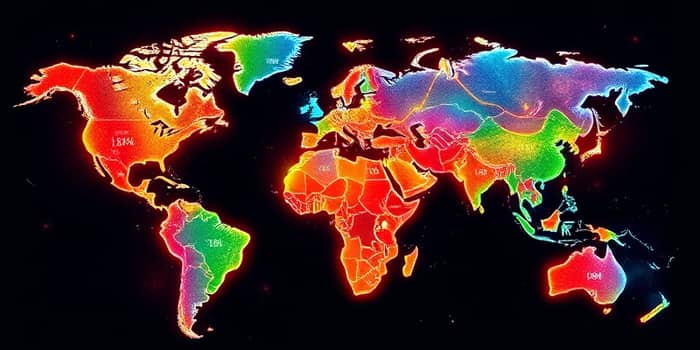
As 2026 unfolds, businesses and individuals alike seek clarity in a shifting global landscape. By analyzing key economic indicators and understanding regional nuances, we can chart a more informed path forward.
Global Economic Outlook for 2026
Forecasts for 2026 cluster around modest expansion, with growth estimates ranging between 2.7% and 3.3%. This pace remains below pre-pandemic averages as trade tensions, high public debt and uneven investment patterns apply downward pressure.
Meanwhile, inflation is set to ease to approximately 3.1–3.4% worldwide, but persistently high food, energy and housing costs mean cost-of-living pressures persist for many households. Understanding this backdrop helps policymakers and investors adapt strategies in real time.
Regional Growth Patterns and Drivers
While the global average paints a broad picture, performance varies markedly across economies. Leading indicators suggest divergent trajectories shaped by domestic policy, export demand and investment trends.
- United States: Projected to grow 2.0%, buoyed by consumer spending, defense outlays and a surge in AI investment of around USD 500 billion.
- Europe/Eurozone: Modest 1.3% increase, weighed down by U.S. tariffs and fragile export volumes despite infrastructure initiatives in Germany.
- Japan: A 0.9% rise supported by automation gains and wage growth offsetting external headwinds.
- China and Asia: Mixed results; consumption-focused stimulus and tech spending contrast with weak labor markets.
- India and South Asia: Robust 6.6% expansion thanks to services exports, public investment and healthy consumption.
- Africa: Approximately 4.0% growth, limited by debt burdens and climate shocks.
- Latin America and Caribbean: Near 2.3% rise driven by recovering domestic demand and renewed investment flows.
Inflation Trends and Monetary Policy
Global inflation is on a downward trajectory, yet core price pressures endure. Elevated oil prices and supply chain disruptions keep headline rates above central bank targets in many regions.
Monetary authorities in advanced economies are expected to shift toward a neutral stance, balancing a return to price stability with the need to support growth. In parallel, developing economies must navigate higher debt service costs while curbing inflation.
Trade, Investment, and Fiscal Signals
Trade growth has slowed after a brief 2025 rebound, with new tariffs and regulatory uncertainty weighing on export-dependent economies. The renegotiation of USMCA and ongoing tariff front-loading unwind effects will shape cross-border flows.
Investment trends diverge sharply: the U.S. benefits from a wave of equipment spending tied to AI, while Europe lags. China redirects capital toward infrastructure and emerging technologies. Fiscal space remains constrained globally, limiting progress on sustainable development goals.
Risks and Uncertainties for 2026
The global outlook is clouded by escalating geopolitical tensions, potential debt distress in emerging markets and the threat of asset price corrections. Vigilance and flexibility in strategy formulation are critical.
- Downside risks: A sharper-than-expected slowdown if trade disputes intensify or policy coordination falters.
- Geopolitical tensions: Disruptions in energy markets or supply chains could trigger renewed inflation spikes.
- Asset price volatility: Equity and credit markets face valuation pressures amid uncertain growth and rate shifts.
Charting a Path Forward
In this complex environment, stakeholders must leverage data and adopt agile policies. Restoring fiscal buffers, pursuing structural reforms and policy coordination, and investing in human capital and technology will bolster resilience.
By aligning strategic vision with economic signals, businesses and governments can navigate uncertainty and unlock sustainable growth opportunities in 2026 and beyond.
References
- https://unctad.org/publication/world-economic-situation-and-prospects-2026
- https://desapublications.un.org/publications/world-economic-situation-and-prospects-2026
- https://www.imf.org/en/publications/weo/issues/2026/01/19/world-economic-outlook-update-january-2026
- https://www.mercer.com/insights/investments/market-outlook-and-trends/economic-and-market-outlook/
- https://www.spglobal.com/market-intelligence/en/news-insights/research/2026/02/global-economic-outlook-february-2026
- https://www.spglobal.com/market-intelligence/en/news-insights/research/2025/12/top-10-economic-insights-2026
- https://www.oxfordeconomics.com/key-themes-2026/
- https://www.morganstanley.com/Themes/outlooks
- https://www.weforum.org/publications/global-risks-report-2026/digest/
- https://www.cbo.gov/publication/61882
- https://www.worldbank.org/en/publication/global-economic-prospects
- https://economy-finance.ec.europa.eu/economic-forecast-and-surveys/business-and-consumer-surveys/latest-business-and-consumer-surveys_en
- https://www.imf.org/en/publications/weo
- https://siepr.stanford.edu/publications/policy-brief/us-economy-2026-what-watch
- https://policy.desa.un.org/themes/macroeconomic-analysis/world-economic-situation-and-prospects-2026